Dinner on The Grounds
When Laura Ingalls Wilder published Little House in the Big Woods in 1932, she did more than write a children’s story. She preserved a way of life that was already beginning to disappear—a life rooted in faith, family, hard work, and the simple joy of gathering around the table.
Many of us grew up turning the pages of those books, imagining life on the prairie and wishing we could sit beside Ma Ingalls in her cozy kitchen. Later, many of us shared those same stories with our own children through the beloved television series. Now a new generation is discovering the Ingalls family through Netflix’s new Little House on the Prairie adaptation.
One of the opening episodes beautifully captures a tradition that was once the heartbeat of country churches across America. As a new preacher arrives, Caroline Ingalls gathers the women of the community to prepare a Dinner on the Grounds. Sawhorses and rough-cut boards from the sawmill become long serving tables, draped with white sheets borrowed from nearby homes and decorated with jars of fresh- picked wildflowers. Before long, those humble tables are filled with the bounty of many faithful hands.
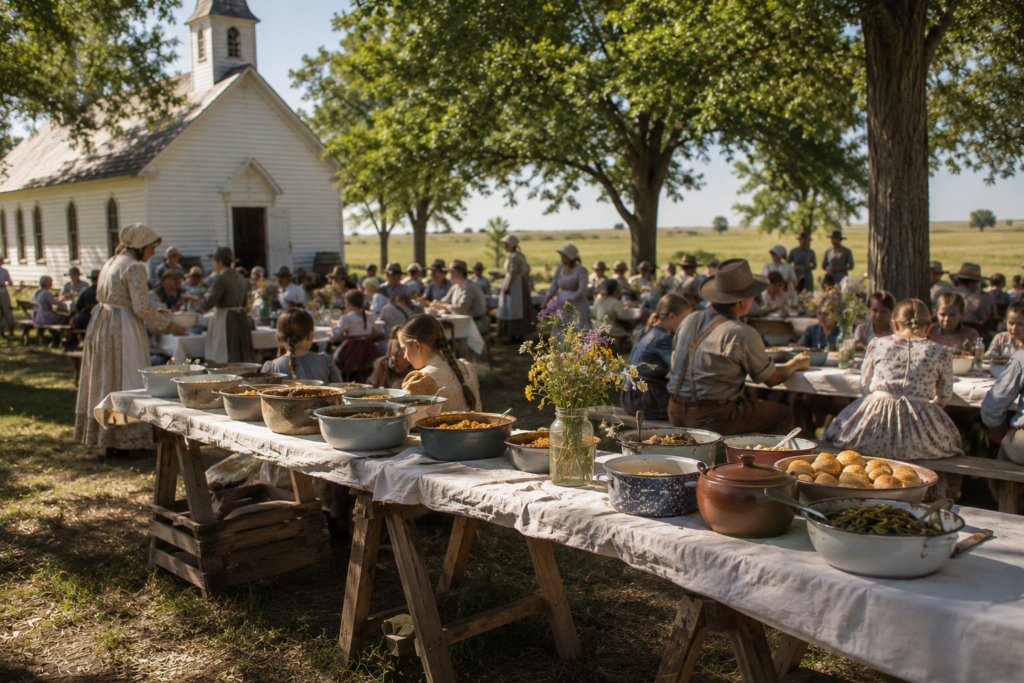
It is a simple scene, yet it reveals something far greater than a shared meal. It is a picture of the Body of Christ—ordinary people serving one another with extraordinary love. There was a time when nearly every country church looked forward to Dinner on the Grounds Long tables overflowed with fried chicken, homemade casseroles, vegetables fresh from backyard gardens, biscuits still warm from the oven, cakes layered with love, and pies made from recipes worn soft with years of faithful use. Every family brought what they had, and somehow there was always more than enough.
But the greatest blessing was never the food.
It was the fellowship.
Children ran barefoot through the churchyard while grandparents caught up on family news. New neighbors were welcomed like old friends. Laughter drifted beneath the shade trees. Prayers were quietly shared. Burdens became lighter. Friendships grew stronger. Around those tables, lives were nourished as surely as stomachs.
The early church understood this well. Scripture tells us they “broke bread in their homes and ate together with glad and sincere hearts” (Acts 2:46). From the Last Supper to the breakfast Jesus prepared beside the Sea of Galilee, meals have always been woven into God’s story of love, grace, and fellowship. A shared table reminds us that everyone is welcome in the family of God. The recipes I will be sharing over the coming weeks come from treasured church cookbooks collected from small towns and country churches across the South. Some were purchased while traveling, others came from church fellowship halls where I enjoyed a meal after worship, attended a fundraiser, or gathered with friends for a special occasion. These cookbooks may have simple covers and spiral bindings, but inside are priceless treasures.
They are more than collections of recipes.
They are the stories of faithful church ladies who measured with experience instead of measuring cups, deacons who tended the barbecue pits before sunrise, Sunday school classes that raised money for mission trips, youth camps, new fellowship halls, and families who lovingly prepared meals for the sick, the grieving, the lonely, and the newcomer. Their pages are seasoned with generosity, hospitality, and quiet acts of
service.
Every recipe carries a little testimony. Each handwritten note and food-stained page whispers of God’s faithfulness through generations of people who understood that feeding others is one of the simplest and most beautiful ways to share the love of Christ.
That is the heart behind the Mystery Cookbook Series.
Each cookbook invites us to discover the history, traditions, and treasured recipes that have gathered God’s people around the table for generations. More than preserving recipes, we are preserving a legacy of faith, fellowship, and hospitality—one church cookbook at a time.
So pull up a chair. Pass the biscuits. Pour another glass of sweet tea, and linger a little longer.
You may come looking for a recipe, but my prayer is that you’ll leave remembering the people who first shared it—and the God who has always gathered His children around the table.