Choose • Clear • Create • Close
Reclaiming My Main Shop, One Area at a Time
I’ve realized something about clutter: mine isn’t necessarily caused by having too much stuff. It’s often caused by too many unfinished decisions.
A project waiting to be finished.
Something I bought to resell but haven’t priced.
Supplies from yesterday’s project.
A treasure without a home.
An idea I’m afraid I’ll forget.
Before long, all those little unfinished decisions begin covering my work surfaces and filling every available corner.
So instead of trying to “get organized” all at once, I’m using a simple four-part system:
CHOOSE • CLEAR • CREATE • CLOSE
And I’m beginning right here in the main shop at Southern Ivy Emporium.

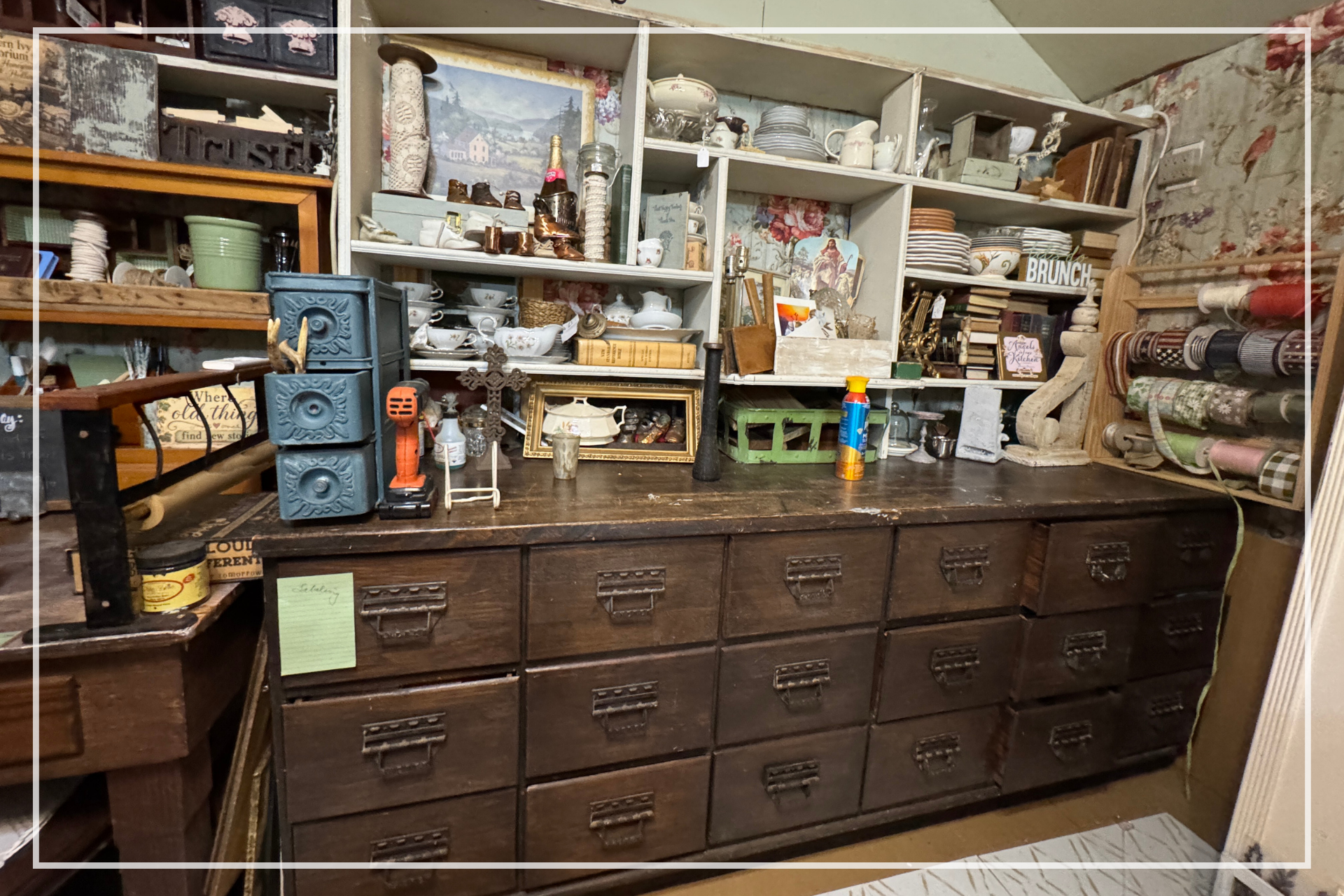
Looking at this room, I can see something important: there are wonderful bones here. My old store cabinets, worktables, shelves, drawers, cubbies and vintage storage pieces are exactly the kinds of things I love.
The problem isn’t that I need a prettier room.
I need the room to work again.
CHOOSE
First, I choose one area and decide what I want that area to do.
I am not organizing the whole shop today.
I might choose the big store cabinet.
Or the worktable.
Or the sewing and fabric corner.
Or the shelves behind my counter.
Then I ask:
What is the purpose of this space?
My main shop needs to help me make, finish, price, photograph and prepare things to sell. Anything that continually interferes with that purpose needs to be reconsidered.
CLEAR
Next, I clear the chosen area. But “clear” does not mean pulling everything out of every drawer and creating an even bigger mess. I know where that road leads!
Instead, I work in a small section and make decisions as I go. Things belong in a few basic categories:
Keep here. Move somewhere else. Sell. Give away. Finish. Toss.
The goal is not simply to make an empty surface. The goal is to remove everything that prevents that area from doing the job I chose for it.
CREATE
This is the fun part.
Once an area is cleared, I create a space that supports the way I actually work. My big store cabinet can become true project storage. My worktable can become a finishing station instead of a holding station.

Fabric can live together. Packaging and tags can have a home. Tools I use constantly can stay within reach.
And the beautiful vintage pieces I love can still be part of the room — but they need to either serve a purpose, tell the Southern Ivy story, or be offered for sale. I’m not trying to turn my shop into a sterile organizing-store showroom. I want it to look like me.
Collected. Creative. Useful. A little old-fashioned. And ready for something wonderful to be made.
CLOSE
This may be the most important step of all.
I have to close the loop.
Finishing a project isn’t enough. If I make a crow, finish a lantern or arrange a bouquet, it doesn’t go back onto the worktable to wait for another day.
I finish it. I price it. I record it in inventory if needed. I photograph it if needed. I pack it into the crate for the appropriate shop or put it directly into a display.
Then I put away the tools and supplies I used. That project is closed. Closing is what keeps yesterday’s creativity from becoming tomorrow’s clutter.
So this is where I’m starting.
Not with the whole house.
Not with every business.
Not even with the whole shop.
One area at a time.
Choose what the space is supposed to do.
Clear what keeps it from doing it.
Create a space that supports the life and work happening there.
Close every project and decision before moving on.
Then choose the next little corner. I have a feeling that somewhere underneath all these projects, supplies, vintage treasures and half-finished ideas is the shop I loved in the first place. And I intend to find her again.
Choose • Clear • Create • Close
Start with what matters most — and finish what you start.